The log-rank statistic models random variation in the survival statistics of a population due to finite sampling effects.
Introduction
The Kaplan-Meier (KM) method is one way to estimate the survival curve \(S(t)\) of a population based on observed event and censoring times. The method is extremely simple – below we will implement the method using numpy in two lines of code. The basic idea is that the probability of survival \(S(t)\) at each time point \(t\) is a free parameter to be estimated subject to the condition that \[S(t+\Delta t) = S(t)P(\text{survive to }t + \Delta t|\text{survive to }t)\]
One question that often comes up when computing KM survival curves is whether two curves are significantly different. For instance, we may have two groups of patients, each group on a different medication, and we want to know if the groups have different chances of survival. The log-rank test is one commonly-applied technique to address this question. In this post, we will give a visual demonstration of this key statistical test.
Problem Setup
We start by simulating patient data with a known survival curve. Since KM is a non-parametric method, let’s at least use a survival curve that’s complex enough to not be simply modelled by an exponential. An interesting example is a survival curve in which the initial hazard rate is quite large, but over time the hazard decreases, as illustrated below. This example could be applicable to a medication in which most patients experience severe side effects early on, but over time the risk for severe events decreases.
Code
def sigmoid(x):return1./(1+ np.exp(-x))def generate_two_phase_hazard( rate_1: float, rate_2: float, transition_time: int, transition_dur: int, observation_time: int):# divide by 2 between the window is symmetric about the transition time transition_dur = transition_dur /2 time = np.linspace(0, observation_time, observation_time +1) hazard =\ rate_1 * sigmoid(-(time - transition_time) / transition_dur) +\ rate_2 * sigmoid( (time - transition_time) / transition_dur) return hazarddef compute_survival_from_hazard_rate(hazard_rate): hazard_rate = np.hstack((np.array(0), hazard_rate[:-1]))return np.exp(-hazard_rate.cumsum())rate_1 =1./90# 1 event per 60 daysrate_2 =1./180# 1 event per yearobservation_time =365*5transition_time =90transition_dur =45hazard_rate = generate_two_phase_hazard(rate_1, rate_2, transition_time, transition_dur, observation_time)survival_function = compute_survival_from_hazard_rate(hazard_rate)assert np.isclose(survival_function[0], 1)survival_function = survival_function / survival_function[0]
Figure 1: Theoretical survival curve and hazard rate for toy problem
Let’s now simulate 100 patients subject to the above survival curve and see that we can use the Kaplan-Meier approach to estimate the survival curve. In generating these data, we also include censoring, that is, patients which leave the study without experiencing an event. The censoring is completely at random with a constant rate.
Code
def sample_survival_times( n_patients: int, survival_function: np.array) -> np.array:# sample survival times survival_samples = np.random.rand(n_patients) observation_time =len(survival_function) survival_times = observation_time - np.searchsorted(survival_function[::-1], survival_samples) return survival_timesdef generate_survival_data( n_patients: int, survival_function: np.array, censor_rate: float) -> pd.DataFrame:# require a non-increasing survival function that begins at 1assert survival_function[0] ==1assert np.all(survival_function[:-1] >= survival_function[1:])# sample survival times survival_times = sample_survival_times(n_patients, survival_function)# apply censoring --# censoring is basically a competing survival process, in this case# with an assumed constant rate time = np.linspace(0, len(survival_function), len(survival_function) +1) censoring_survival = np.exp(- censor_rate * time) censoring_times = sample_survival_times(n_patients, censoring_survival) patients =list(range(n_patients)) time_to_event = np.minimum(survival_times, censoring_times) censoring_flag = np.argmin(np.vstack((survival_times, censoring_times)), axis=0)return pd.DataFrame.from_dict({'patient':patients,'event_time':time_to_event,'is_censored':censoring_flag }) n_patients =100censor_rate =1./180cohort_1_events = generate_survival_data(n_patients, survival_function, censor_rate)cohort_1_events
patient
event_time
is_censored
0
0
155
0
1
1
69
0
2
2
23
0
3
3
8
0
4
4
155
1
...
...
...
...
95
95
40
1
96
96
40
0
97
97
87
1
98
98
10
0
99
99
103
0
100 rows × 3 columns
Kaplan-Meier Curve
In order to calculate the KM curve, we first aggregate the patient data by event time as follows:
In the last column, we added the estimated differential probability of survival in a given interval, computed as
\[P(\text{survive to }t + \Delta t|\text{survive to }t) \approx 1 - n_{events} / n_{at\_risk}\]
Now the calculation of the KM curve is exceedingly simple. The overall survival curve is then given by the cumulative product of the values in this column. The resulting survival curve estimate is shown below.
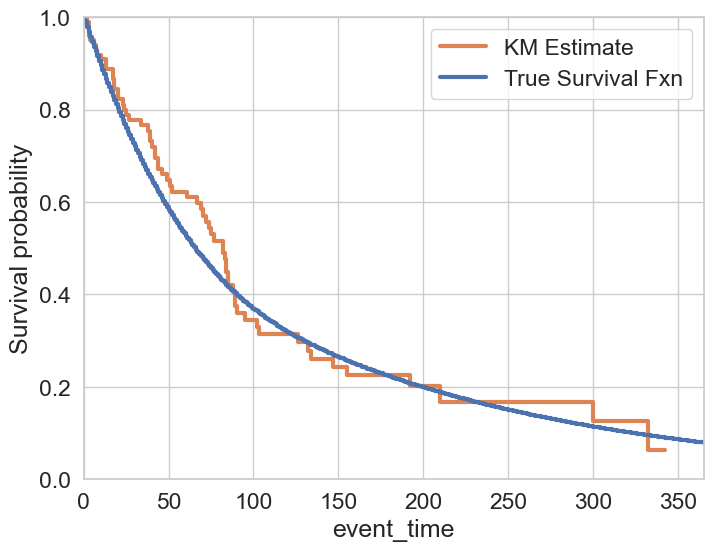
Figure 2: Comparison of true survival curve to survival curve estimated with Kaplan-Meier.
As we can see, the estimated curve does not exactly match the theoretical curve. This difference is to be expected due to the finite number of samples we have.
Log-Rank Test
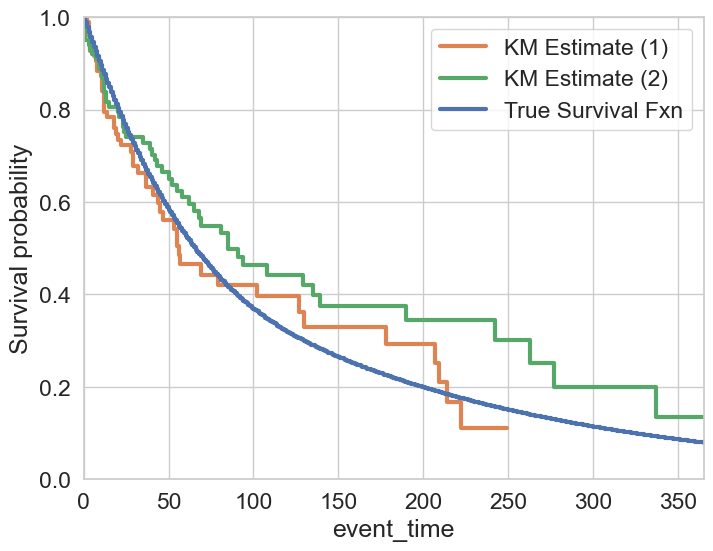
To understand the log-rank test, let’s now consider multiple (independent) samples of 100 patients. By construction, we know the survival curves for the two subgroups are identical, but we will see random fluctuations in the estimated KM curve.
Figure 3: Random variations in KM estimate due to finite sampling effects
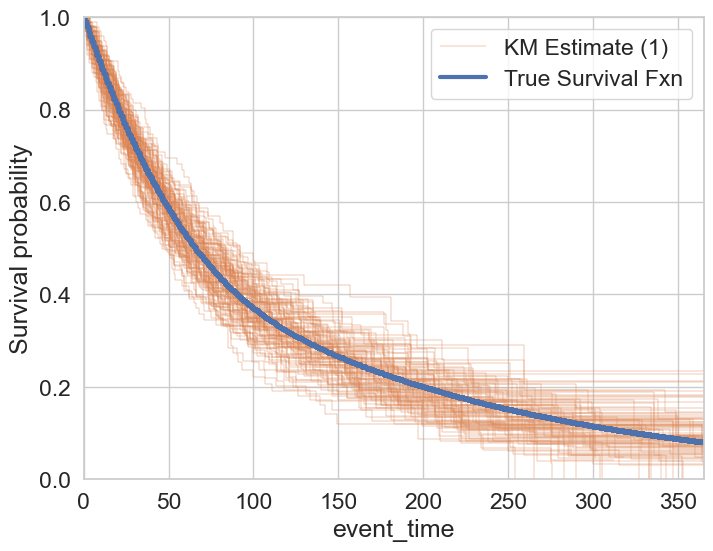
Figure 4: An ensemble of random KM curves drawn from the same underlying population.
Above we show an ensemble of 100 random Kaplan-Meier curves drawn from the same underlying population. The plot shows the individual KM curves, each representing survival data from different random splits of the cohort. For comparison, we have drawn also the true survival function, and we see that variations in the estimated KM curve arise out of finite sampling effects. The variation in these estimated curves indicate the expected variation in the KM estimate under the null hypothesis that the the survival curves are the same.
To compute the log-rank statistic, we assume that events are distributed randomly between the two groups. For instance, if there are 3 events in a certain time period, 91 patients in group 1 and 90 patients in group 2, then we should expect on average there to be \(3 * 91 / 181\) events in group 1 and \(3 * 90 / 181\) events in group 2. See the table below.
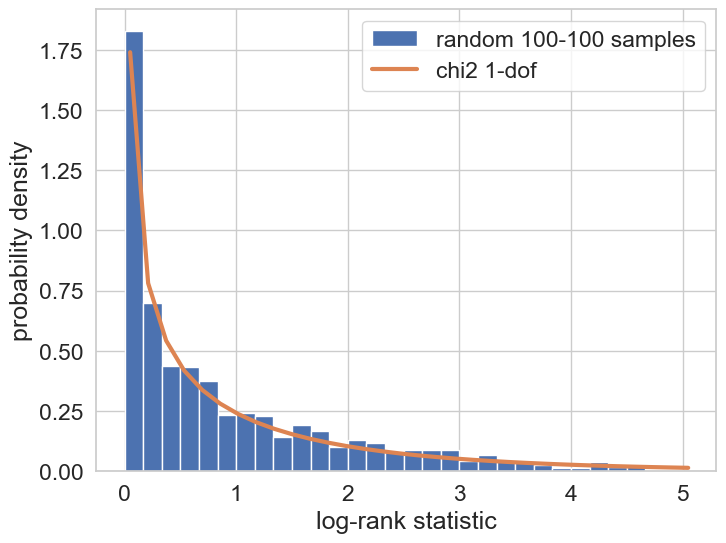
Now for each of the ensemble pairs generated in the previous plot, we compute the log-rank statistic and plot the histogram of these below. We see that the distribution of the log-rank statistics matches well a \(\chi^2\) distribution with one degree-of-freedom. A high value of the log-rank statistic indicates that it is unlikely for the curves to have come from the same underlying survival distribution.
Code
lr = []for _ inrange(1000): split_agg_1, split_agg_2 = generate_km_curves_random_cohorts(n_patients, survival_function, censor_rate) df_log_rank, lr_stat = compute_log_rank(split_agg_1, split_agg_2) lr.append(lr_stat)from scipy.stats import chi2fig = plt.figure(figsize=(8,6))_ = plt.hist(lr, bins=np.linspace(0, 5, 31), density=True, label='random 100-100 samples')X =0.05+ np.linspace(0, 5, 32)y = [chi2.pdf(x, 1) for x in X]plt.plot(X, y, linewidth=3, label='chi2 1-dof')plt.xlabel('log-rank statistic')plt.ylabel('probability density')plt.legend()
Figure 5: Distribution of log-rank statistic for random samples of 100 patients having the same underlying survival curve.
Conclusion
In conclusion, we explored the sampling distribution of Kaplan-Meier curves and seen that sampling effects leads to variation in the observed KM curve. The log-rank tests measures when differences in KM curves are larger than one would expect by pure chance, when the underlying populations are the same.